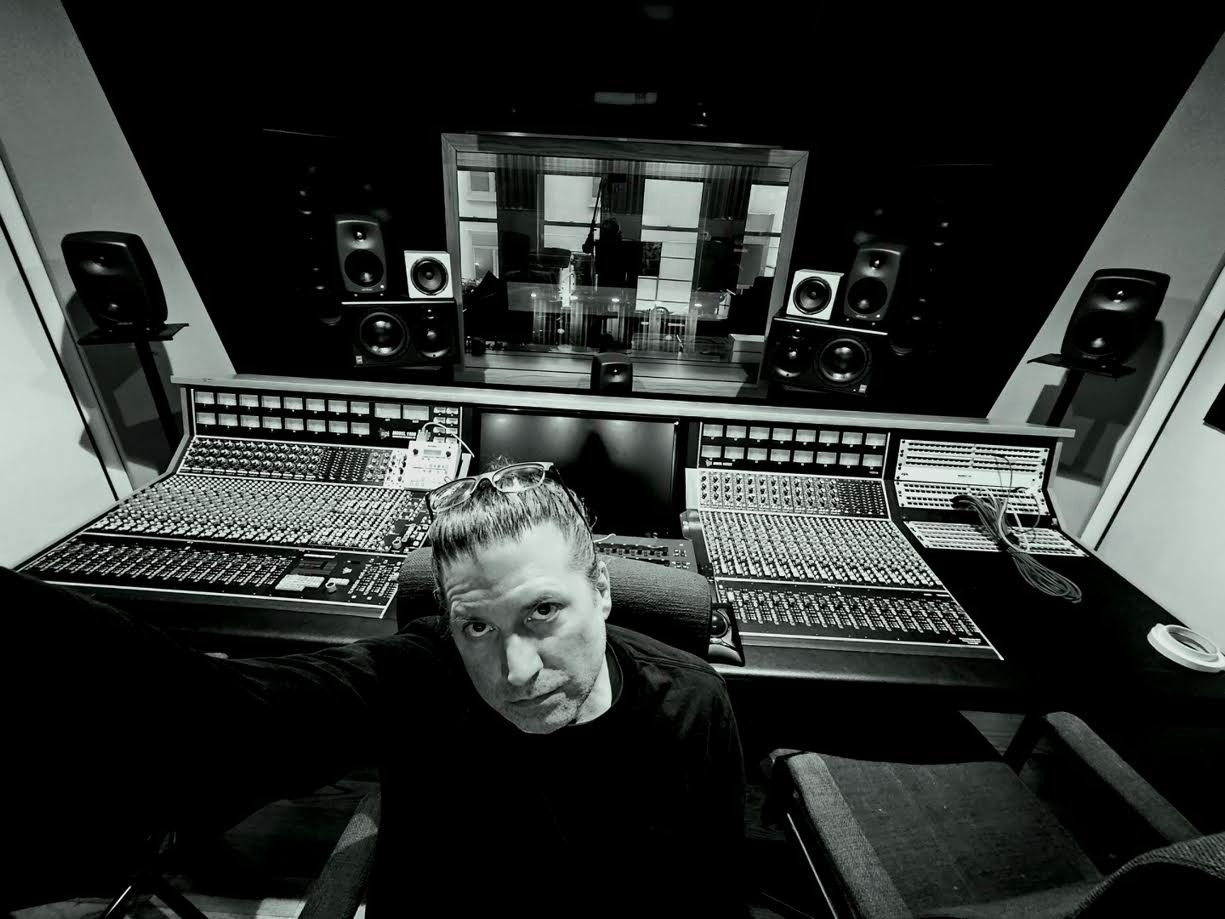
The Invisible Runway: How David Sisko Scores a Fashion Show
A fashion show is more than what you see on the runway, it’s what you hear and feel, too. When the music isn’t in sync with the clothing, models, and overall stage atmosphere, the fashion brand can lose its impact. Composer, producer and New Yorker David Sisko discusses his creative work on the fashion runways in particular, his work with the streetwear brand Sprayground.
This is the first creative talk article in a four-part series that will inform and educate readers about music for fashion.
Q: What’s up Sisko, nice to meet you again. I am interested in your music fashion project.
A: Hello Naratama. How have you been? So nice to see you again! Yes, I’ve worked on quite a lot of fashion music.
Q: So tell me, as a producer, composer, film scorer, sound designer, mixer, and DJ, how do these different roles come together in your musical practice, particularly when creating music for a fashion show?
A: Composing and producing music for a fashion show taps into multiple disciplines from my practice in sound and music, in many aspects. It's a live movie, set to a particular theme, a visual theme, and a thematic narrative. So I'm not only utilizing skills and ideas learned in the film and television world, but also in the clubs, and from my experience as a DJ, and even from the world of academia. It's like composing a long score that has to sound fantastic throughout, which may include sound design interludes, vocal narrations, and other surprises so my skills in mixing and recording come in extremely handy, especially in the world of vocal and narrative recording.
I am a person who loves to "world-build", and the fashion show is the perfect platform. Building worlds is something I have done in my imagination for as early as I can remember. And on top of all of this, the fashion world has some of the best design eyes and ideas, so you have to make sure that you bring that same level of quality and creativity.
Q: From your perspective, what is fashion music?
A: Fashion music is an open-ended question because fashion itself is open-ended. Most people equate it with beat-driven, dance-oriented, tempo-based music, timed to the walk, the strut down the runway. But as time has moved on, we've seen designers use all types of sound. The one thing they all have in common is a pulse, a creative pulse that belongs to the line itself, a sonic bridge between what the audience is seeing on stage and their own perception of the presentation.
For London, the brief from Sprayground was not just music it was atmosphere, narrative, and immersion. The sound began an hour before the first look, as the guests arrived, and it didn't end until the last guest had departed. The score became an invisible runway of its own. For Sprayground, I worked very closely with David BenDavid, the brand's founder and creative director, and with Sandflower Dyson, the show's creative director of content, runway, and casting.
Q: Do you find that pulse inside the clothes or bring it to them?
A: Both. You are feeding off the designs that are provided and you are complementing those designs based on your own vision. And there's a third element that comes together with a show: the overriding themes, the title of the show, the names of the outfits, the names of the line, the names of the pieces. And of course, who the line is catering to the clientele, both business-to-business and the clientele direct, the fans of the brand.
Q: What makes it different from ordinary music?
A: Quite possibly nothing differentiates it. It's contextualized for the runway. The runway itself is a medium of delivery, a vision is delivered, and the sound has to be catered to that vision. And keep in mind the word medium: a piece of music could exist on the radio, in a club, in a concert hall, or in an academic classroom but if you arrange it, contextualize it, so that it fits the runway show itself, it becomes fashion music, and that same piece can exist in other places.
What matters more is how the music is organized and arranged together, how the pieces flow in and out of each other. That's probably the demarcation of what makes this music different. It's like a Broadway show or a film: all of the music in all of these places could technically be used in the other mediums, but it's how it's presented. And in that way, the word I would look for is "continuously" presented continuously, but for a short period of time, however long the show is, from fifteen minutes to forty-five minutes, depending on the nature of the line and the designer being presented. London stretched that further: the runway itself was 25 minutes of electro, house, trap, funk, and new wave flowing seamlessly but the continuous piece of music the audience lived inside ran two and a half hours.
Q: Is a designer's playlist of existing songs, organized to the show, also fashion music?
A: Kind of. The reason I say kind of is that there are pieces of music that hold so much visual and narrative information already. Take a common theme from the movies to the opening titles of Blade Runner and the original Blade Runner. There are only so many places you could play that piece of music where it would not evoke Blade Runner. So not every playlist will work, because too much context, too much narrative from those already-existing pieces of music would then be applied to the fashion line and that might not be what the fashion designer wants. Or, if it were a fashion line licensed from Blade Runner to be on the runway, you might need exactly that.
Q: Music can sometimes feel disconnected from what’s happening on the runway. Why does this happen, and what makes music such an essential part of a fashion show?
A: Well, the reason music can feel disconnected is that sometimes you're dealing with multiple visions. Or it could be a poor, disconnected vision from the designer, or from the composer. Or you're simply dealing with people coming from different countries, different generations, different tastes in music in general.
The reality is, that's why it's important for the composer and the designer to work very close at hand, almost from the beginning, to map out what looks and sounds good together. And the reason I say that is that's what I've done in the past, and it has worked very well in my favor. If you're working step by step with the designer, and showing the designer swatches of sonics, swatches of sound, like you would show swatches of clothing, patterns, or materials, it's easier to move forward. That's exactly how London happened.
Six weeks before the show I was walking Freemasons' Hall, reading the building. And the theme of the show Your Energy Is True was born at a dinner table in Chinatown, at Pho Grand, Sandflower and I trading wordplay over bowls of pho until the phrase arrived. The music and the show grew out of the same conversations.
Q: Do you think that fashion deserves something more than borrowed mainstream tracks chosen for a fast beat or strong rhythm?
A: There are times when a designer has to utilize a well-known piece of music because of the context that's being brought to the table. I used Blade Runner above; you could use a piece like Beethoven's Fifth, or Vivaldi's Four Seasons, or any number of famous songs in pop and rock history and that's okay, as long as it doesn't overwhelm what's happening on stage. Sometimes a designer feels that the crowd has to be entertained, so they use music to cover up that, to help that process but the designer's also risking the fact that it might be disconnected from their own clothing line. So I think you can be open, and mix genres and sounds and styles, depending upon the line and the designer, to make a successful show.
Q: Why is it important to create original musical concepts, compositions and arrangements that reflect the designer's vision and complement the collection?
A: The reason it's important to create original music concepts is the same as the answer to why it is important to create original fashion concepts. Because sound and vision change over time. And you want your audience, the people, to react to something new. Because fashion, in large part, is always something new. London is my proof. The score's foundation was the building itself; the symmetry and ratios of Freemasons' Hall became geometric rules for the music's rhythm, texture, and flow. That's an original concept no existing track could have given the show, because it belonged only to that room, that collection, that night.
Q: How did you approach the process of creating music for such a large collection (52 looks)?
A: The first thing you do when there's a large-scale project like this is you step back from it all. You speak to the designers, and you ask them how long the presentation is going to be. You begin sharing sounds for those looks, and you realize that each individual look doesn't need its own sound. What's more important is that the overall vibe of the show has to fit what's on the stage. You start building, little by little, the things that absolutely work for what's going to be presented on stage. And from that point you're going to find out in what order those outfits and visions will be presented, and then you organize the energy of the music based upon that.
For London, that meant building the show as three movements instead of 52 separate cues: Arrival a full hour of music as the guests came in; the Runway for 25 minutes; and Departure another hour as they left, with a three-minute spoken-word poem and African drumming as the doorway in between. The looks didn't each get a song. They got a world to walk through.
Q: How did you maintain musical continuity across all 52 looks?
A: This is where DJ skill comes in or the fact that I've put together many, many mixtapes in my life. At A Slight Angle To The Universe, for one a continuous mix of 28 artists, sequenced to play as one piece. There's a certain point in the production of the show where you step back with all of the sounds you've created, and pieces of music, and look at the entire presentation as a mixtape and sequence the music accordingly, right before the show begins. A few days ago. London ended that way. We finished the score in New York, then sat with producer Nadeem Daya at TYX Studios in London to finalize the sequencing, the titles, and the mastering the continuous mix got wider and deeper in that room, days before the show.
Q: Where do you usually find your inspiration when developing musical ideas for a fashion show?
A: Musical inspiration can come from the designer themselves, the clothes, who they are as a spirit. But it also comes from my inherent love of music. With many elements in life, I'll see a scene, or I'll see something, I'll even see the clothes, I'll watch a movie, I'll play a video game and sometimes, in my own head, I'm replacing the music as I'm watching something. I do the same thing with actual musical artists: I'll watch musical artists on stage perform songs, and I think to myself, well, maybe they could be doing a song like this, or like that. Meaning you take all of those inspirations, and all of those instincts, and then you organize all of them, and align them, for a fashion show. Returning to the Freemasons' Hall example, it is an archive of symbolism and walking through it, I felt more like an archeologist than a composer.
Q: How much influence do beats and rhythms have on the way a fashion show is experienced by the audience?
A: Beats and rhythms can be the superstructure of the building known as the runway. Underneath every great building there is a structure, think of it as the stanchions and the girders, the strength of what's happening whether the beats and the rhythms are loud, or inferred, or quiet. And then from that point you can change the types of sounds that are used if it's percussion from Bali, or Java, or the Middle East, or Africa, or South America.
So you can create the structure by which everything can fit and flow. In London, the score was equal parts heartbeat, architecture, and dreamscape and the percussion holding it up came from everywhere: daf, tabla, tarbuka, cajón, djembe, and the gamelan family reyong, rindik, suling. You could feel the girders, even when you couldn't see them.
Q: Can the music tempo change how people perceive the models' pose and runway walk, or the overall mood of a collection?
A: Obviously, there has to be a range of tempos in which the pace of the show can fit. The music can't be too slow or too fast or at least perceived as too slow or too fast, compared to what's happening on the runway. That's a whole art unto itself, of creating a feeling in a room. Sometimes, for example, you can use very slow, throbbing beats, and it's so dramatic and emotional, yet the models can walk fast and you're creating a kind of third feeling. So the music is one way, the models and the runway are another, and a third thing is formed. The same with hyperkinetic speed beats: those can create a feeling of chaos, and again can be used, if that aligns with the vision of the designer. London ran on deliberate tempos. Arrival was 60 bpm, slowing-down from the chaos of the street outside. The runway was 124. The finale, I Can't Stop with the London Contemporary Voices, lifted to 142. And Departure sent everyone home at 120, brighter and warmer. The audience may not have counted a single beat but they felt every one of those decisions.
Q: What advice would you give a young designer or composer preparing for their first fashion show? What should they understand about the role of music before they begin?
A: Like preparing any great meal, a meal where hundreds of people may be invited, it's important not only to start with very good ingredients, but to make sure they're organized, and that they're the correct ingredients for the meal you want to make. Do that well, and you may be asked back to make another meal, this time in a different genre, a different flavor, a different cuisine.
To Be Continued…
Check out: www.sisko.com / IG : @davidsisko
New York - November 2026 / Photo by David Sisko